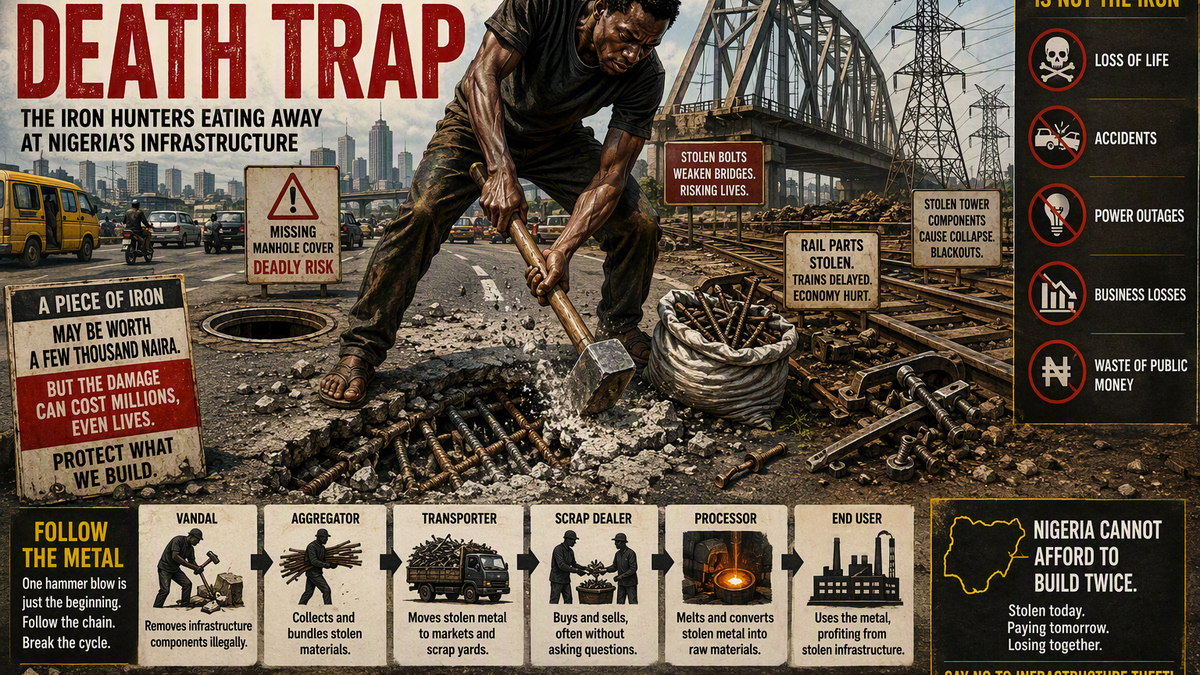
A man attacks a road with a hammer. He is not repairing it. He is breaking into the concrete to extract the iron rods inside.
The metal may be worth only a few thousand naira, but the damage can endanger motorists and pedestrians and weaken infrastructure that may have cost millions or billions of naira to build.
This is the disturbing transformation of Nigeria’s scrap-metal economy. What may once have been ordinary scavenging is increasingly taking the form of deliberate destruction of property and infrastructure that people still depend on.
Across Nigeria, scrap collectors are commonly known as “iron condemn” pickers, scavengers or Baban Bola. There is nothing inherently criminal about collecting genuinely discarded metal for recycling. The problem begins when people stop recovering waste and start dismantling functioning infrastructure because its components can be sold.
The distinction is straightforward. Collecting discarded metal is recycling. Removing a railway component, bridge fitting, electrical cable, manhole cover or road barrier without permission is theft. When the target is critical infrastructure, the consequences can go far beyond the value of the stolen material.
The question Nigeria must now confront is what happens when the scrap market begins consuming the infrastructure itself.
A National Problem
The evidence is appearing in different parts of the country.
In Lagos, authorities reported in August 2026 that about 1,800 manhole covers had been stolen from the Lagos section of the Lagos-Calabar Coastal Road since January. About one kilometre of fencing and 75 directional signs were also reportedly stolen.
In the South-East, the First and Second Niger Bridges have also faced vandalism concerns. The Federal Government has raised alarm over the reported removal of bolts and other metal components from the older bridge, while the Second Niger Bridge has suffered the theft of metal fittings and other components.
In Kaduna State, the Nigeria Security and Civil Defence Corps has reported arrests and the recovery of stolen railway materials. Authorities have also uncovered operations involving the processing and transportation of large quantities of railway components for the scrap market.
The electricity network has not been spared. The Transmission Company of Nigeria has repeatedly reported vandalism of transmission infrastructure, including attacks in which structural components are removed from towers, sometimes causing them to collapse and disrupting electricity supply.
There have also been videos circulating on social media showing suspected scavengers breaking open concrete culverts and road structures to extract reinforcement bars.
Taken together, these incidents show that this is not simply a northern, southern or urban problem. It is a national challenge in which public infrastructure is increasingly being viewed as a source of scrap.
The Real Cost Is Not the Iron
The value of the stolen metal is often insignificant compared with the damage it can cause.
A manhole cover may fetch relatively little at a scrap yard, but its absence can result in a fatal accident. A bridge bolt or steel fitting may have little value as scrap, yet perform a critical structural function. A railway component removed for sale can disrupt an entire service. A transmission-tower component can contribute to the collapse of a structure and interrupt electricity supply to communities.
The true cost therefore includes far more than the price of the metal. It includes replacement, repairs, traffic disruption, business losses, interrupted public services and, potentially, loss of life.
The thief captures the private value of the metal. The public bears the much larger cost of what that metal was doing before it was removed.
Nigeria Already Has Laws
Nigeria is not without laws that can be used against infrastructure vandalism.
Existing criminal laws provide offences covering theft, receiving stolen property and damage to property. The Electricity Act 2023 contains specific provisions dealing with the theft, possession and transportation of stolen electricity infrastructure and materials. The Nigeria Security and Civil Defence Corps has statutory responsibility for protecting critical national assets and infrastructure, while other regulatory frameworks apply to scrap collection, recycling and metal processing.
The challenge is therefore not simply the absence of legislation. It is enforcement, coordination and the market into which stolen materials disappear.
A person caught removing a manhole cover or railway component may be arrested. But what happens to the person who bought it, the transporter who moved it, the dealer who accepted it or the processor who melted it down?
If enforcement stops with the person physically carrying the stolen material, the wider business model remains intact.
Follow the Metal
The person with the hammer is only the visible end of the chain.
Behind the vandal may be a buyer, transporter, aggregator, scrap dealer, processor or industrial user. Some transactions are legitimate, but others may involve people who know, or should reasonably suspect, that the material was stolen.
Nigeria therefore needs to follow the metal.
Where did it come from? Who sold it? Who bought it? How was it transported? Where was it processed? Who ultimately paid for it?
This does not mean treating every scrap dealer or collector as a criminal. It means distinguishing ordinary recyclable waste from materials that are strongly associated with stolen infrastructure.
A truckload of discarded aluminium cans presents a very different risk from a truckload of railway steel, electrical cables, bridge components or manhole covers.
Nigeria should therefore adopt stronger traceability requirements for high-risk scrap. Dealers handling such materials should record the identity of sellers, the type and quantity of metal, its declared source and the transaction details. Larger transactions should be traceable, while major processors should be able to account for significant quantities of high-risk material entering and leaving their facilities.
The objective is simple: make stolen infrastructure difficult to convert into anonymous scrap.
Lessons From Other Countries
Nigeria is not the first country to discover that a profitable scrap market can become a market for stolen infrastructure.
Britain offers the clearest evidence that regulating the downstream market can make a difference. The Scrap Metal Dealers Act 2013 introduced stronger licensing, seller identification and transaction-record requirements and restricted cash payments. Police-recorded metal theft in England and Wales subsequently fell from 62,075 offences in 2013 to 15,947 in 2020, a 74.3 per cent reduction. Infrastructure-related metal theft also fell by about 74 per cent. The British Government has acknowledged that regulation was not the only factor behind the decline, but concluded that the Act contributed to reducing metal theft.
South Africa offers another important lesson because the problem has involved critical infrastructure on a large scale. In 2022, the government estimated that metal theft was costing the economy more than R47 billion annually. It reported that about 742 kilometres of Eskom cable had been stolen and that cable theft cost Transnet approximately R2 billion in lost revenue in 2021. South Africa responded with measures aimed at strengthening controls over scrap dealers and exports, improving the ability to establish the origin and destination of scrap and restricting cash transactions.
Australia has placed greater emphasis on prevention and cooperation. Its approach includes registration of scrap-metal businesses, transaction records, restrictions on cash payments and reporting of suspicious transactions. Australian crime-prevention research has also highlighted cooperation among police, infrastructure owners and legitimate recyclers, alongside property marking and information sharing.
The lesson for Nigeria is not that regulation alone will eliminate metal theft. It is that the economics of the crime can be changed.
When stolen metal can be sold anonymously and quickly converted into untraceable scrap, theft remains attractive. When dealers must identify sellers, record transactions and account for high-risk materials, stolen infrastructure becomes harder to monetise.
Nigeria does not need to copy any foreign system wholesale. It can adapt the most practical elements to its own circumstances.
Make Infrastructure Harder to Steal
Regulation should be combined with better infrastructure design.
Where appropriate, manhole covers should be made more difficult to remove. Cables can be protected, vulnerable fittings secured and critical components marked. Railway equipment, transmission infrastructure and other valuable public assets should, where practical, carry identifiers linking them to an owner and location.
Technology can provide another layer of protection. Solar-powered cameras, tamper alarms, vibration sensors and other monitoring systems can be deployed around particularly vulnerable bridges, railway corridors, power installations and construction sites.
The goal is not to put a policeman beside every bridge or railway line. It is to make vulnerable infrastructure capable of signalling when someone is attempting to dismantle it.
Protect Recycling, Target Theft
There is an important balance to maintain. Nigeria should not respond to infrastructure vandalism by criminalising legitimate recycling.
The informal recycling economy provides livelihoods and recovers large quantities of material that might otherwise become waste. Someone collecting discarded aluminium or genuinely abandoned metal should not be treated in the same way as someone dismantling a railway track.
The regulatory approach should therefore be based on risk. The defining question should be simple: was the material discarded, or was it taken?
That distinction would allow Nigeria to protect legitimate recycling while closing the market for stolen infrastructure.
What Nigeria Should Do Now
The response needs to be coordinated. The Police, NSCDC, infrastructure owners, environmental regulators, Customs, prosecutors and legitimate scrap dealers need a common framework for identifying high-risk materials, sharing intelligence and pursuing organised networks.
The country should also examine whether existing penalties and prosecution procedures adequately reflect the consequences of vandalising critical infrastructure. Removing a bridge component or railway track is not an ordinary property offence. It can endanger lives and disrupt essential services.
But tougher penalties alone will not solve the problem if stolen metal remains easy to sell. The priority should therefore be to attack the entire chain: prevent theft where possible, identify vulnerable components, trace high-risk scrap, scrutinise suspicious transactions, investigate buyers and processors, and prosecute those who knowingly participate in the trade.
Nigeria Cannot Afford to Build Twice
Nigeria already faces a huge infrastructure deficit. The country needs more roads, bridges, railways and reliable electricity, not a cycle in which newly built infrastructure is dismantled and taxpayers are forced to pay for repairs.
Every naira spent replacing stolen infrastructure is money that could have been used to build something new.
The answer is not to wage war on scavengers or shut down the scrap industry. It is to ensure that legitimate recycling does not become a convenient market for stolen public assets.
Nigeria should make legitimate scrap easy to trade and stolen infrastructure difficult to sell.
The measure of success should not simply be the number of arrests. It should be whether infrastructure theft is falling and whether stolen public assets are becoming harder to sell.
Nigeria is spending billions to build the infrastructure it needs for development. It must also protect what it has built.
A piece of iron may be worth only a few thousand naira as scrap. But if that iron is holding up a bridge, carrying electricity, securing a railway or covering a road opening, its real value is measured by what happens when it is gone.
August 2026
Abuja.