How Did We Get Here?
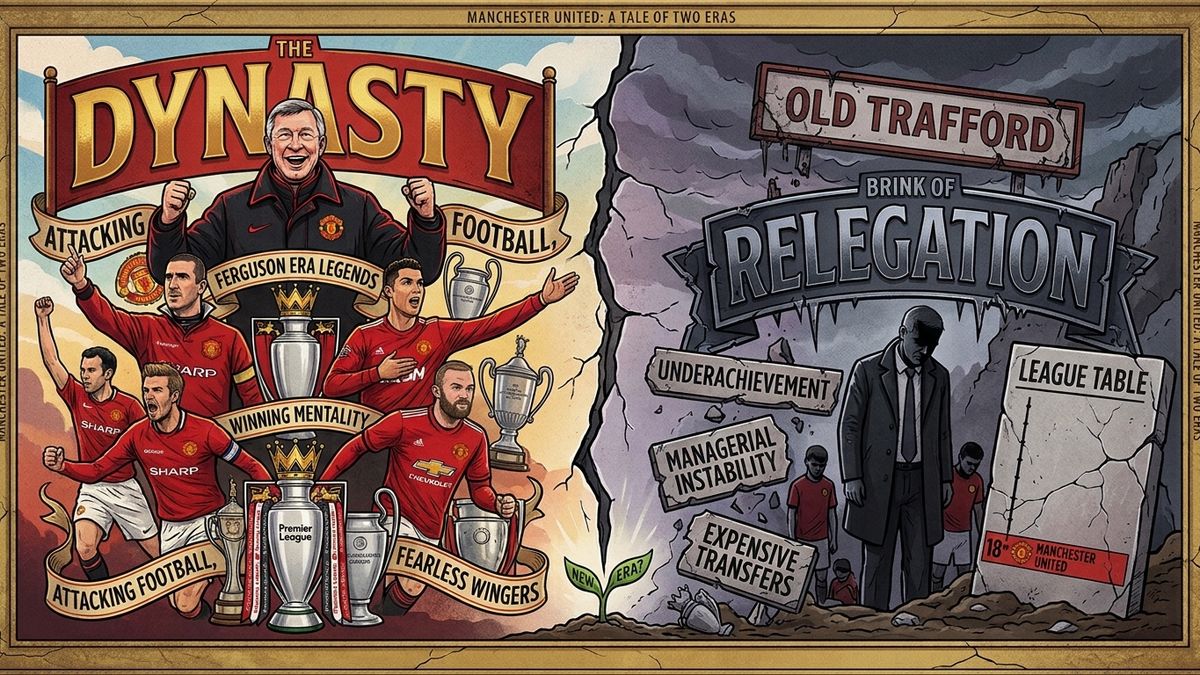
There was a time when Manchester United represented everything that made football exciting: attacking football, fearless wingers, dramatic comebacks, a winning mentality and the belief that no match was lost until the final whistle.
Under Sir Alex Ferguson, United dominated English football and conquered Europe, becoming one of the greatest clubs in football history. Yet, since his retirement in 2013, the club has endured managerial instability, expensive transfers and years of underachievement. Trophies have occasionally been won, but the consistency, identity and dominance that defined United have disappeared.
Now, the possibility of relegation has entered the conversation. As a supporter, this is painful to contemplate. But it also raises important questions: What went wrong? Who or what is responsible? And could even this crisis become an opportunity to rebuild?
Remembering the Ferguson Era
When Ferguson arrived at Old Trafford in November 1986, United had gone several years without winning the league title. Over nearly 27 years, he transformed the club, winning 13 Premier League titles, five FA Cups, four League Cups and two Champions League trophies, among other honours.
His teams were not just successful; they were exciting. Think of Ryan Giggs, David Beckham, Paul Scholes, Cristiano Ronaldo, Wayne Rooney and Eric Cantona. United played with width, pace, creativity and an appetite for goals. They combined attacking freedom with discipline, youth development, intelligent recruitment and an uncompromising winning mentality.
United won the Premier League in Ferguson's final season, 2012/13, finishing 11 points ahead of Manchester City. Few could have imagined the struggles that would follow.
Ferguson's Departure: The Beginning of the Decline
Ferguson's retirement in 2013 marked the end of an era. But United also lost chief executive David Gill, key members of Ferguson's coaching team, including Mike Phelan and René Meulensteen, and several important senior players who departed or retired around that period.
David Moyes, appointed on Ferguson's recommendation, struggled to manage the transition. Despite winning the Community Shield, he was dismissed before the end of his first season, with United finishing seventh and missing Champions League qualification.
The problem went deeper than one unsuccessful managerial appointment. United had lost much of the experience, leadership and institutional knowledge that sustained the Ferguson era. The club had not adequately prepared for life after its most influential manager.
Ferguson left a remarkable legacy, but United failed to establish a structure capable of protecting it.
The Managers Who Followed: A Cycle of Changing Directions
Since Ferguson's departure, United have experienced a succession of permanent, interim and caretaker managers, each bringing different philosophies and approaches.
- David Moyes (2013–2014): Ferguson's chosen successor. Won the Community Shield but was dismissed after United finished seventh.
- Ryan Giggs (Caretaker, 2014): Took charge for the final four matches of the 2013/14 season.
- Louis van Gaal (2014–2016): Won the FA Cup but was criticised for cautious, uninspiring football.
- José Mourinho (2016–2018): Won three trophies, including the Europa League, and finished second in the Premier League, but eventually departed amid internal disagreements.
- Ole Gunnar Solskjær (Interim, 2018; Permanent, 2019–2021): Restored some attacking excitement, finished second in the league and reached a Europa League final, but won no trophies.
- Michael Carrick (Caretaker, 2021): Briefly took charge for three matches following Solskjær's departure.
- Ralf Rangnick (Interim, 2021–2022): Arrived to steady the team but struggled to improve performances.
- Erik ten Hag (2022–2024): Won the League Cup and FA Cup but failed to establish consistency.
- Ruud van Nistelrooy (Caretaker, 2024): Took charge for four matches following Ten Hag's dismissal.
- Rúben Amorim (2024–2026): Failed to establish a sustainable winning project and left in January 2026.
- Darren Fletcher (Interim, January 2026): Briefly took charge for two matches following Amorim's departure.
- Michael Carrick (Interim, January–May 2026; Permanent, May 2026–present): Helped United finish third in 2025/26 before taking the permanent position.
The lesson is not that every manager failed. Mourinho and Ten Hag won trophies, while Solskjær brought periods of genuine promise. The problem is that every managerial change seemed to trigger another rebuilding exercise.
United kept changing managers without establishing a consistent footballing philosophy. The club needed continuity in its footballing direction, not simply continuity in the manager's name.
The Constant Factor: Ownership and Governance
Managers, players and coaches have changed, but the underlying ownership and governance structure has remained a major constant.
The Glazer family acquired United through a leveraged takeover in 2005, attracting sustained criticism from supporters over debt, investment priorities and the club's direction.
Sir Jim Ratcliffe and INEOS arrived in 2024, bringing significant changes to football operations, but the Glazers retained overall voting control.
It would be unfair to blame every failure on ownership. Managers, players and recruitment executives must also accept responsibility. However, the club's leadership must answer for years of inconsistent recruitment, poor succession planning and managerial instability.
United need more than another manager. They need competent football leadership, sustainable investment, intelligent recruitment and accountability throughout the organisation.
Relegation Anxiety: A Club at a Crossroads
Manchester United's 4–4 draw against Aston Villa on 8 November 2026 offered a dramatic glimpse of the fighting spirit supporters have long associated with the club. Twice trailing by two goals, United rescued a point through late strikes from Joshua Zirkzee and Patrick Dorgu.
However, the comeback did little to ease the bigger concern: United remain 18th in the Premier League, with just eight points from ten matches and only one league victory.
For a club that has not been relegated from the English top flight since 1974, this is an alarming position. The late fightback showed character, but the defensive weaknesses and inability to turn performances into victories remain deeply worrying.
As a fan, it is difficult to watch a club of United's stature fighting to escape the relegation zone rather than competing for honours.
There is still a long season ahead, and survival must remain the immediate priority. But this should be a wake-up call: United's problems go far beyond disappointing results and require urgent, lasting solutions.
Relegation: A Setback or an Opportunity for Rebirth?
Relegation would be devastating. Reduced broadcasting revenue, commercial losses, financial pressure and the possible departure of key players would make rebuilding difficult. Attracting top talent and returning to European competition would also become harder.
And, on a more personal note, I cannot begin to imagine the relentless teasing I would have to endure from Yemi, Muyiwa and Ayo. I can already picture the WhatsApp messages, endless jokes and football banter. I suspect they would make sure Dayo and I never forget it! Relegation would give these gentlemen a lifetime supply of ammunition.
Jokes aside, the thought of watching United play Championship football while traditional rivals compete for major honours is painful and difficult to imagine.
However, I do not believe relegation would destroy the club. United still have a global following, enormous commercial strength and resources that most Championship clubs cannot match. More importantly, if relegation happens, it could force the club to confront problems that years of managerial changes and expensive transfers have failed to resolve.
Rather than treating it as a temporary inconvenience, United should use the crisis to rebuild fundamentally by:
- Restoring the football identity: Establish an attacking philosophy built around pace, creativity, intensity and a winning mentality.
- Rebuilding the squad: Retain committed players and recruit young, hungry and technically gifted footballers who fit a clear footballing plan.
- Reviving the academy: Give young players genuine opportunities, continuing the tradition of the Busby Babes and the Class of '92.
- Reforming recruitment and governance: Establish competent football leadership, intelligent recruitment, financial discipline and long-term planning.
- Reconnecting with supporters: Build a team that plays with courage, ambition and pride in the Manchester United shirt.
The objective must be to rebuild the institution, not simply assemble a team capable of winning promotion. Relegation should never be welcomed, but if it happens, United must ensure they do not return to the Premier League with the same problems that took them down.
Lessons from Clubs That Have Bounced Back
Football history shows that relegation does not necessarily mean the end of a club's ambitions.
Manchester City were relegated from the Premier League in 1996 and subsequently dropped into the third tier in 1998. They returned to the Premier League in 2000, although their eventual transformation into a European powerhouse came much later, following major investment and restructuring.
Newcastle United were relegated in 2009 but won the Championship in 2009/10 and returned immediately. Their recovery demonstrated the importance of retaining a competitive squad and establishing a clear promotion objective.
Leicester City were relegated in 2004, returned to the Premier League in 2014 and remarkably won the title in 2015/16.
These examples do not mean relegation guarantees success. Many clubs have struggled for years to return. The lesson is that a club's response to adversity can determine its future.
What Should the New Manchester United Look Like?
Whether United survive or are relegated, the club needs a rebuilding strategy that combines the attacking excitement of the Ferguson era with the tactical sophistication of modern football.
My vision is a team that:
- Plays attacking football with width, pace, creativity and purpose.
- Has a technically gifted midfield capable of controlling games.
- Develops young players and gives academy graduates genuine opportunities.
- Recruits intelligently rather than spending excessively on individual names.
- Has a manager supported by a competent, permanent football leadership structure.
- Holds everyone accountable, from the boardroom to the dressing room.
I would favour a flexible attacking system, such as 4-3-3, encouraging creativity, aggressive pressing and positive football.
The club should also have a realistic five-year ambition: stabilisation in the first year, consolidation in the second, European qualification in the third, a serious title challenge in the fourth and sustained competition for domestic and European honours by the fifth.
These are ambitions, not guarantees. They require patience, sound financial management and, above all, a plan that survives beyond individual managers.
We Do Not Need Another Sir Alex Ferguson
Perhaps the greatest lesson from the last thirteen years is that United became too dependent on one extraordinary individual.
Ferguson was a remarkable manager, but no football institution should need another person of his unique stature simply to function successfully.
We need a system that preserves the club's identity regardless of who manages the first team: strong leadership, excellent recruitment, outstanding youth development, attacking football and a culture of accountability.
We should celebrate Ferguson's achievements without becoming prisoners of nostalgia. The objective is not to recreate 1999 or 2008, but to build a Manchester United capable of producing its own great teams and creating new memories.
Conclusion: From Crisis to Opportunity
As a Manchester United supporter, I do not want relegation. I want to see my club competing for the Premier League and Champions League, playing exciting football, developing fearless young players and making Old Trafford a ground opponents dread visiting.
But United cannot continue doing the same things and expect different results.
If relegation happens, it will be painful and costly. Yet it could also force the club to confront the institutional problems that have remained unresolved since Ferguson's departure.
The opportunity would be to rebuild properly, not merely secure promotion and return to the same mistakes. We must not confuse returning to the Premier League with returning to greatness.
Sir Alex Ferguson built a dynasty. The next challenge is to build an institution worthy of that legacy.
Glory, Glory, Man United!